
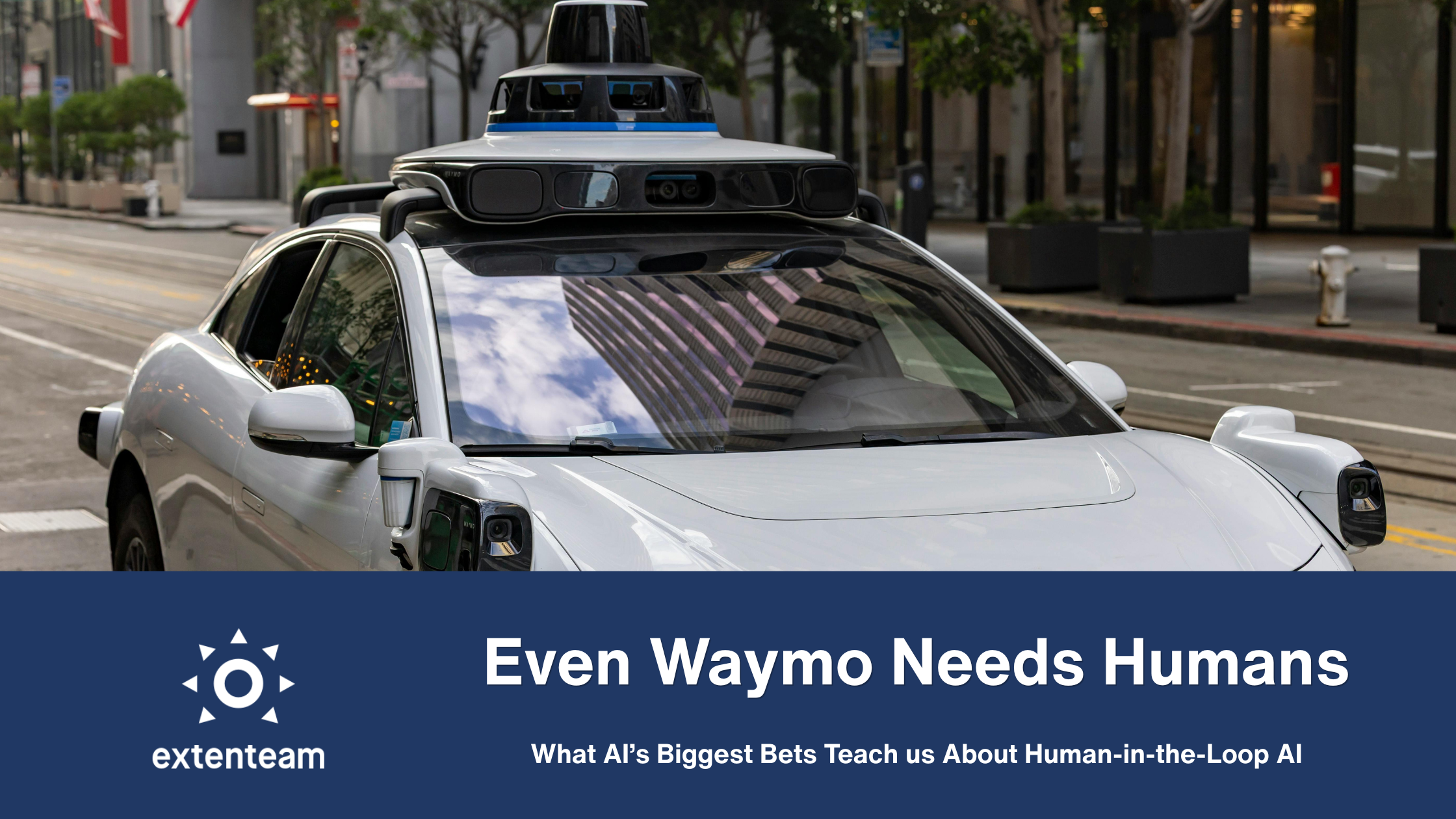
Have you ever taken a Waymo ride? If not, here's what to expect: no driver, no steering wheel in use, just the car doing its thing. The experience tends to leave people feeling safer than they expected. It's a 10x better driver than most humans: no distractions, no bad days, no phone-checking. Genuinely impressive.
But here's what makes Waymo's success even more interesting: the AI doesn't do it alone.
When Waymo's robotaxis encounter something genuinely complex, an unusual intersection, an unexpected road closure, a situation the AI hasn't seen before, they're designed to ask for help. A network of roughly 70 remote assistance agents, located in Arizona, Michigan, and the Philippines, step in to provide guidance. These humans aren't driving the car, but they are making the judgment calls the AI can't make alone. The car handles the driving; the humans handle the hard decisions.
This is intentional. Waymo built its system with the understanding that even the most sophisticated AI will encounter edge cases, and that those moments require human intelligence. Rather than pretending AI can handle everything, Waymo engineered a seamless handoff. The result is a safer, more reliable experience for passengers precisely because humans are still in the picture.
It's a model worth paying attention to. The most impressive thing about Waymo isn't that it removed humans from the equation. It's that it figured out exactly where humans add the most value and built the whole system around that insight.
That lesson didn't come without growing pains. In March 2026, a Waymo robotaxi got stuck and blocked an ambulance responding to an active shooting in Austin, Texas. No remote agent resolved it quickly enough, and a police officer had to manually drive the car out of the way. It was a stark reminder that even well-designed human-AI systems have gaps, and that the handoff between machine and human has to be faster, clearer, and better resourced than anyone initially assumes. This incident didn't discredit the model; it sharpened it.

Waymo isn't alone. Across industries, the past two years have been a masterclass in what happens when companies treat AI as a human replacement rather than a human amplifier.
Klarna made headlines in 2023 when it replaced roughly 700 customer service agents with an AI chatbot built in collaboration with OpenAI. The bot handled two-thirds of all customer queries. Wall Street loved the efficiency story. Then quality cratered. Customer satisfaction dropped. Complaints piled up.
By spring 2025, CEO Sebastian Siemiatkowski was publicly acknowledging that Klarna had "overestimated AI's capabilities and underappreciated the human aspects of service delivery." They began rehiring, building a hybrid model that blended AI speed with human judgment. Gartner had predicted this outcome years earlier: by 2027, half of companies that cut customer service staff because of AI would need to rehire.
The lesson isn't that AI is bad. It's that AI alone is incomplete.
Look at the AI deployments that are actually working in healthcare, finance, logistics, and customer experience and you'll find humans at key checkpoints. They're reviewing AI outputs before they go live. They're catching the edge cases the model didn't train for. They're handling the moments that require empathy, local knowledge, or judgment that can't be reduced to a pattern.
This is what researchers call human-in-the-loop AI, and 2025 marked a turning point: it stopped being a best practice and started being a survival strategy. Companies that had moved too fast, automating without preserving human accountability, started pulling back. New regulations including the EU AI Act began mandating transparency and oversight for high-stakes AI decisions.
The insight isn't complicated: automation handles volume; humans handle complexity. The question is never "AI or humans?" It's always "where does each one add the most value?"
Extenteam spends a lot of time thinking about this balance. Property management, especially short-term rentals, is an industry being transformed by AI tools: dynamic pricing engines, smart locks, automated guest messaging, AI-generated listing copy. These tools are genuinely powerful.
But the moments that make or break a guest experience are a different story. A 2 a.m. emergency. A guest who's confused and escalating. A maintenance issue that requires someone to actually understand the property's history. These aren't algorithm problems. They're human problems.
Extenteam's shared service is, in a way, the same thing Waymo is doing with its fleet response agents: building the human layer that allows automation to actually work. Hospitality-trained humans handle the handoffs that AI can't manage alone, the judgment calls, the relationship-building, the real-time problem-solving that keeps guests happy and owners protected.
The property managers who are thriving right now aren't the ones who automated everything. They're the ones who automated the right things and kept the right humans in place for everything else. Learn more about how Extenteam helps short-term rental operators scale.

That first Waymo ride was a genuine thrill. But the reason those cars work, the reason they can navigate complex city traffic without incident most of the time, is because there's a human somewhere ready to step in when the algorithm hits its edge.
The same is true for any property management business.
AI is a force multiplier, not a replacement. The companies that understand this, that design their operations with humans and technology rather than instead of humans, are the ones building something durable. The ones that don't are either already hiring people back or waiting to learn what Klarna learned the hard way.
The future isn't human or AI. It's human with AI. And the smartest investment a property management company can make right now is making sure the right humans are in place when it matters most.
Extenteam is the orchestration layer for your property management business. AI handles the day-to-day, and when a human touch is needed, our hospitality-trained team steps in seamlessly. You focus on growth. We handle the rest. Learn more.


Hear from iTrip Sarasota's owner on how Extenteam has exceeded his expectations when it comes to hiring remote talent.
The following video is from an online conference organized by Rental Scale-Up. Today’s vacation home


.webp)

.webp)

Let's connect to find the best solution for your team.
.jpeg)

"The communication has definitely been a big help and because you guys are so responsive especially late at night. You guys have just been so helpful and I think your mannerisms and the the promptness of how fast you respond have been very effective and very important."

Extenteam streamlines operations for Property Managers by providing top global talent and innovative software solutions, all while maintaining a “service-first” approach to drive success and efficiency.
