
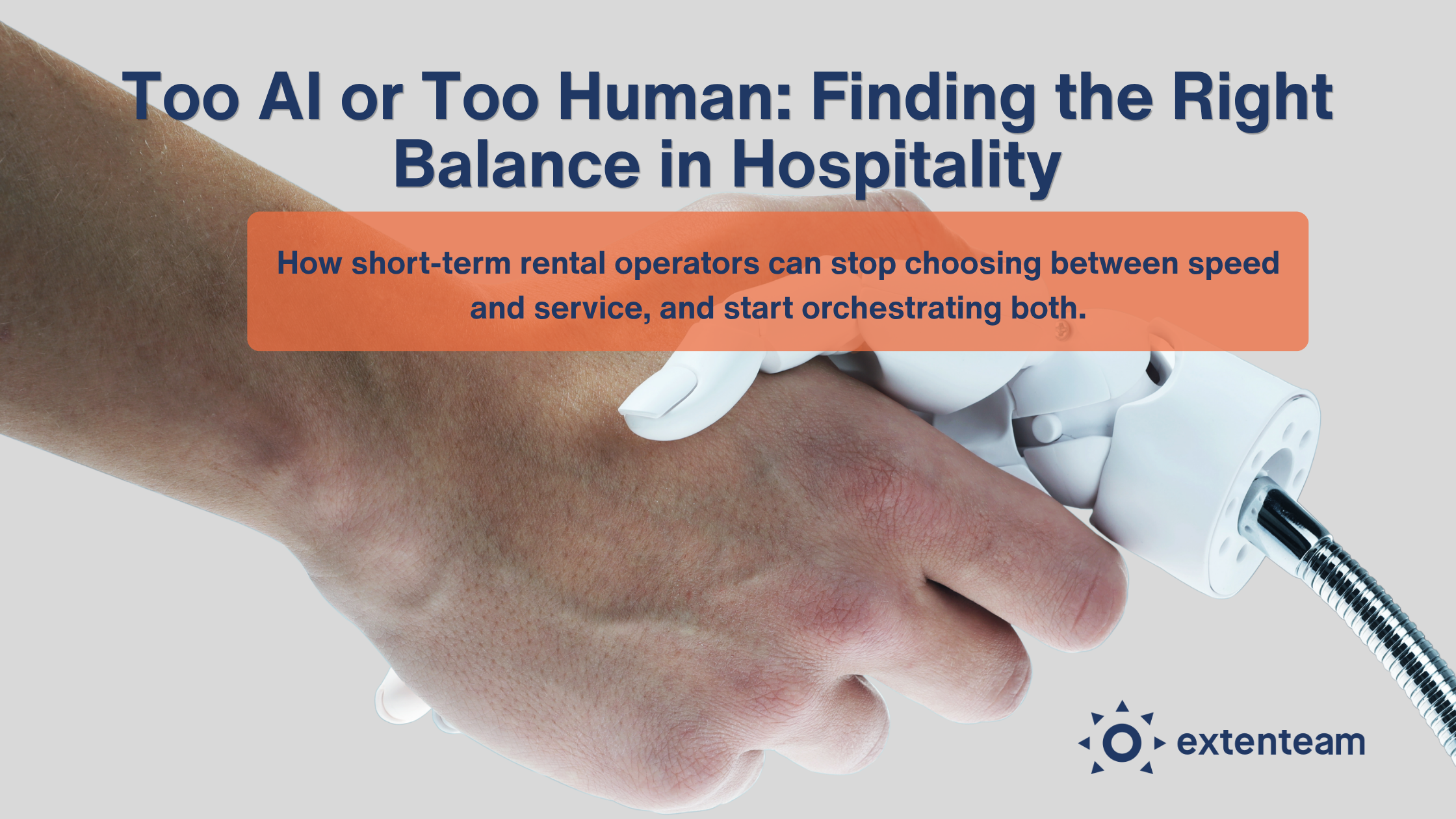
Ask ten short-term rental operators how they feel about AI and you'll get ten different answers. Some have gone all-in on chatbots, auto-responders, and generative replies. Others still have a single overworked team member pecking out every guest message by hand at 11:47 PM. Most are somewhere in the messy middle, experimenting, stitching tools together, and quietly wondering whether they're leaning too far one way or the other.
It's a fair question. Because in hospitality, the cost of getting the balance wrong is high. Tilt too far toward AI, and guests feel like they're talking to a vending machine. Tilt too far toward humans, and your team burns out, response times slip, and margins evaporate as you try to scale.
The good news: you don't have to pick a side. The operators pulling ahead in 2026 aren't choosing between AI and humans. They're orchestrating both.
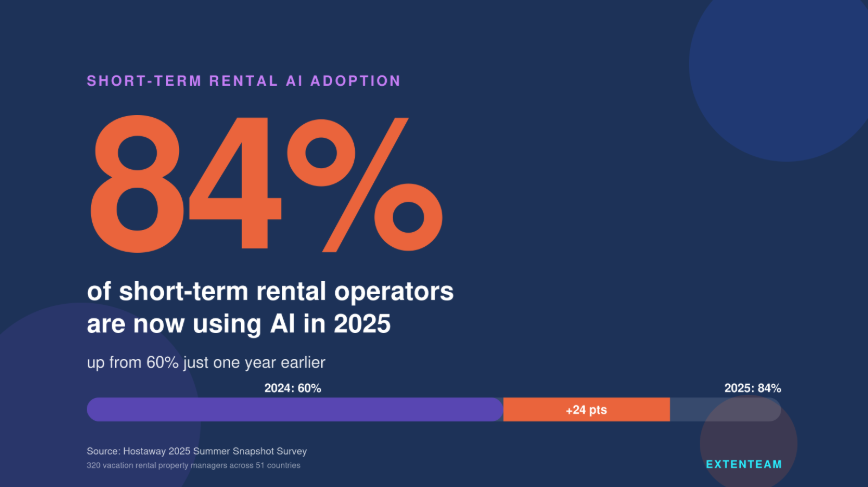
The adoption numbers tell you where the puck is going. Hostaway's 2025 Summer Snapshot Survey of 320 vacation rental property managers across 51 countries found AI adoption jumped from 60% in 2024 to 84% in 2025. In a single year, AI went from experiment to expectation for Airbnb and VRBO operators.
Why the stampede? Because the math is brutal for anyone trying to handle it manually. Routine Airbnb and VRBO messages (Wi-Fi passwords, check-in windows, parking, late checkouts, local recommendations) never stop, and they never respect business hours. STR guests are now judging vacation rentals against the hotel standard, and a host team that can't respond at 2 AM doesn't get a pass for being "just a rental."
And guests aren't resisting the shift. SiteMinder's 2025 Changing Traveller Report, which surveyed 12,000 travelers across 14 markets, found 78% are open to using AI during their accommodation journey, as long as it stays out of the interactions they consider personal.
Translation for STR operators: if you're still answering "what time is check-in?" at midnight, your competitors aren't. They've automated that, and redirected the time they saved into the moments that actually move reviews and revenue.
Here's the catch. Adopting AI is not the same as using it well.
We've all seen the failure modes. A guest asks a nuanced question about a local restaurant for their anniversary and gets a canned list of the top five Yelp results. A cleaner flags a broken water heater and the system auto-replies "thank you for your feedback" before routing it into a ticket queue no one is watching. A five-star guest who has stayed with you eight times gets the same generic welcome message as a brand-new booking.
Skift's 2025 hospitality research puts it plainly: "The soul of the hospitality business will always lie in its ability to connect human beings — to each other and to the places they visit. By understanding how to use technology as a tool to best serve that purpose, the industry will set itself up to thrive in the years to come."
And guests notice the difference. Timely guest communication is one of the loudest signals in a review, but "timely" is only half the equation. Timely and wrong is worse than slow and right. An AI that confidently tells a guest the hot tub is operational when it's actually undergoing a scheduled repair doesn't just miss the mark. It creates a refund request, a bad review, and a trust problem you'll spend weeks cleaning up.
Here's the catch. Adopting AI is not the same as using it well.
We've all seen the failure modes. A guest asks a nuanced question about a local restaurant for their anniversary and gets a canned list of the top five Yelp results. A cleaner flags a broken water heater and the system auto-replies "thank you for your feedback" before routing it into a ticket queue no one is watching. A five-star guest who has stayed with you eight times gets the same generic welcome message as a brand-new booking.
Skift's 2025 hospitality research puts it plainly: "The soul of the hospitality business will always lie in its ability to connect human beings — to each other and to the places they visit. By understanding how to use technology as a tool to best serve that purpose, the industry will set itself up to thrive in the years to come."
And guests notice the difference. Timely guest communication is one of the loudest signals in a review, but "timely" is only half the equation. Timely and wrong is worse than slow and right. An AI that confidently tells a guest the hot tub is open when it's actually down for repair doesn't just miss the mark. It creates a refund request, a bad review, and a trust problem you'll spend weeks cleaning up.
Now the other side. Some operators resist AI because they believe hospitality is fundamentally a human craft. They're right about the craft part. They're wrong that humans alone can deliver it at scale.
If you manage one to 10 units, a dedicated team can keep up. At 100, the cracks show. At 1,000, the model breaks. Meanwhile guest expectations keep climbing: the same Hostaway 2025 Summer Snapshot Survey found 35% of operators improved their average guest rating year over year, largely through more proactive communication and maintenance. That's the bar your team has to clear, and it keeps rising. Guests want hotel-grade responsiveness, while staying in a vacation rental, across time zones, in their preferred language, at 2 AM.
You cannot hire your way there. Even if you could, headcount-led growth crushes margin. The operators stuck in "too human" mode aren't delivering better hospitality. They're just delivering slower, more expensive, less consistent hospitality while burning out the team that's supposed to be the differentiator.
This is where the conversation usually stalls out, because operators are offered a binary: buy an AI tool or hire more people. The real answer is neither. It's orchestration.
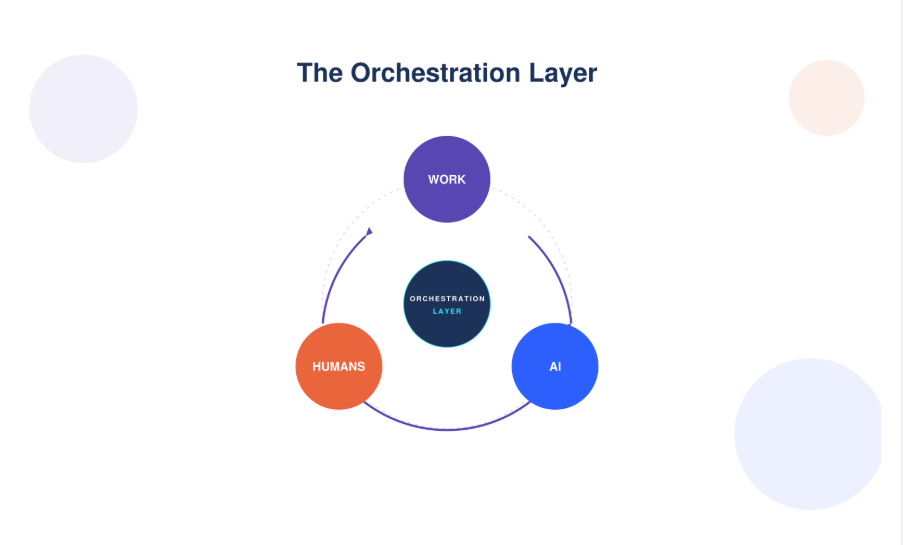
An orchestration layer is the connective tissue that decides, in real time, which work should be handled by AI and which should be handed to a trained human, and then executes both, seamlessly, as a single workflow.
At Extenteam, that's the model we've built specifically for short-term rental operators. We're an AI-powered orchestration layer that automates communication and operational tasks across your portfolio, with humans-in-the-loop exactly where they add the most value: nuanced guest issues, escalations, quality control, and the judgment calls AI still gets wrong. It's not AI or a team. It's AI and a team, working as one system.
In practice, that means:
Guest communication. Routine questions (check-in times, Wi-Fi passwords, parking, late checkout) are handled instantly, 24/7, with accuracy grounded in your property-specific knowledge base. The emotional, complex, or high-stakes messages are routed to a trained team member who already has full context.
Tasks. A guest reports a broken dishwasher at 10 PM. The system classifies the issue, creates the task, assigns the right vendor, updates the guest, and loops in a human the moment judgment is needed.
Reviews, knowledge, and escalations. Patterns get surfaced automatically. Knowledge is captured once and reused everywhere. And when something needs a human (a refund call, a VIP guest, a tricky owner conversation) the handoff is clean, not a cold transfer into chaos.
The point of the orchestration layer isn't to remove people from hospitality. It's to put them exactly where they belong, in the moments that matter, and let intelligent automation handle everything else.
When the orchestration model is working, you'll see it in four places. Response times drop from hours to seconds on routine messages, while complex issues still get a thoughtful human reply. Guest satisfaction and review scores climb because the easy stuff is flawless and the hard stuff gets real attention. Operational costs flatten even as your portfolio grows, because you're scaling through software and shared expertise instead of headcount. And your team actually likes their job again, because they're solving interesting problems instead of copy-pasting Wi-Fi passwords.
That's the shift. Not "too AI" or "too human," but a single, orchestrated operation where each does what it does best.
The question for 2026 isn't whether you adopt AI. 84% of your peers already have. The question is whether you adopt it in a way that makes your hospitality better or cheaper. Those are very different outcomes.
Cheaper is a race to the bottom. Better is a durable advantage.
If you want to run smarter, more scalable operations, whether you're managing 1 unit or 10,000, you don't have to choose between the efficiency of AI and the warmth of a real team. You just need them working in the same system.
That's the balance. And it's the one we built Extenteam to deliver.
Ready to see what AI-powered orchestration looks like in your operation? Book a demo with Extenteam and we'll walk you through it with your portfolio in mind.

Hear from iTrip Sarasota's owner on how Extenteam has exceeded his expectations when it comes to hiring remote talent.
The following video is from an online conference organized by Rental Scale-Up. Today’s vacation home


.webp)

.webp)

Let's connect to find the best solution for your team.
.jpeg)

"The communication has definitely been a big help and because you guys are so responsive especially late at night. You guys have just been so helpful and I think your mannerisms and the the promptness of how fast you respond have been very effective and very important."

Extenteam streamlines operations for Property Managers by providing top global talent and innovative software solutions, all while maintaining a “service-first” approach to drive success and efficiency.
